60-minute session
P.E.A.C.H. Essentials
$750 starting rate
A focused introduction to intentional AI use.
- Understand each P.E.A.C.H. step.
- See a prompt built from start to finish.
- Use the H checklist to review an AI response.
P.E.A.C.H. helps you set a clear goal, choose appropriate evidence, give AI a specific task, and keep your own judgment in the process.

Purpose · Evidence · Assignment · Criteria · Human Review
For work, college, and everyday tasks. Fill in what you know; your entries are not sent to a server.
What are you trying to accomplish, and what context should AI understand?This gives the prompt your goal and situation.
What approved materials or facts should AI use? Avoid sharing private information.This identifies what information AI may draw from.
Give AI one specific, useful task.This states the help you are requesting.
Set the format, limits, and rules the response must follow.This sets the standards for AI's response.
How will you check the response and decide what to revise?After using AI, record what you actually checked, changed, used, and disclosed. This becomes part of your AI-use explanation.
See how the P.E.A.C.H. steps can turn a vague request into a useful learning prompt. Then try building your own below.
Think of a prompt as instructions you give an AI tool. Fill in the letters below, then press Make my prompt. Use AI to help you learn and practice, and follow your teacher's rules.
Get the free K–12 guideYour 3-page guide is free. Educators and families: check the optional email updates box at checkout for student-friendly prompt tips, classroom AI ideas, and new K–12 P.E.A.C.H. resources. The guide is yours either way.
Choose the 33-page digital workbook for deeper lessons, activities for different grade levels, reusable planners, and an educator guide. The free guide helps you make your first prompt.
Tell AI your grade or age group, the subject, and what you want to understand. Example: “I am in seventh grade, and I want to understand fractions.”
Point to your class notes, reading, or facts. You can say, “Use only the notes I provide.” Don't include names or private information.
Ask for a clear learning task, such as an explanation, practice questions, or feedback on your own idea.
Choose a length, format, or rule. Example: “Use simple words, give one example, and don't give me the answers until I try.”
After you use AI, explain what it helped you do, what you did yourself, and how you checked its answer. Copy this part to show your teacher how you used AI responsibly and did your own work. It is not added to the AI prompt.
Make it, copy it, and use it in an AI tool your school or family allows.
Write what AI helped with, what you did yourself, and how you checked its answer.
0 of 5 checks complete
Need to tell your teacher where your AI help came from? Make an AI citation.
Only the number of copied prompts is counted. What you type here stays on your device. Never enter passwords, your address, or someone else's personal information into an AI tool.
Used an AI response in a paper or project? Enter the details from your actual AI conversation. Pick the style your teacher, school, or publisher requires, then copy the citation into your work.
A shared chat may be visible to anyone with its link. Remove personal details before sharing. Your entries stay in your browser and are not saved by this page.
Reference list entry
In-text citation or note
Citing an AI response does not replace citing a book, article, or website you actually used. Check assignment rules: some tasks require an AI-use explanation even when no formal citation is needed. APA guidance · MLA guidance · Chicago guidance
See why a better AI prompt begins with your purpose and ends with your judgment. Watch this quick introduction, then make your first prompt or explore the guided course.
A free, printer-friendly three-page guide to build one useful prompt and review the AI response with your own judgment. Start here, then try the Prompt Possibilities Machine.
Get the free first-prompt guideYour 3-page guide is free. Want more practical prompt tips, thoughtful AI updates, and new P.E.A.C.H. resources? Check the optional email updates box at checkout. The guide is yours either way.
$39 individual digital edition
Choose this 26-page workbook for deeper independent practice grounded in Dr. Combs’s research. Explore five research themes, lessons for each P.E.A.C.H. step, guided exercises, worked cases, and a final capstone.
Buy the workbook — $39Secure checkout and PDF delivery through Payhip · Individual use
$49 one-time enrollment
Choose the course if you prefer guided video lessons. Learn each P.E.A.C.H. step at your own pace, from Purpose and Evidence through Human Review, then revisit the videos whenever you need them.
Take the course quiz when you finish. Once you pass, you can claim your certificate of completion.
Enroll in the course — $49Secure checkout and course access through Payhip
Learn P.E.A.C.H. one-on-one or bring training to your team. Tell Dr. Combs what you need through a short request form. Team dates are confirmed after availability and travel are discussed.
Explore personal and team trainingA focused introduction to intentional AI use.
A guided session for people ready to put the framework to work.
More time for practice, feedback, and organization-specific examples.
A 15-minute planning call. Your $50 consultation fee is credited toward your training fee if you book a P.E.A.C.H. session.
Prices are starting rates per group session, not per person. Training dates, audience, customization, delivery format, and any travel costs are confirmed in a proposal before the booking is finalized. The $50 consultation fee is applied to your training invoice if you proceed; it is not an additional charge on top of the training price.
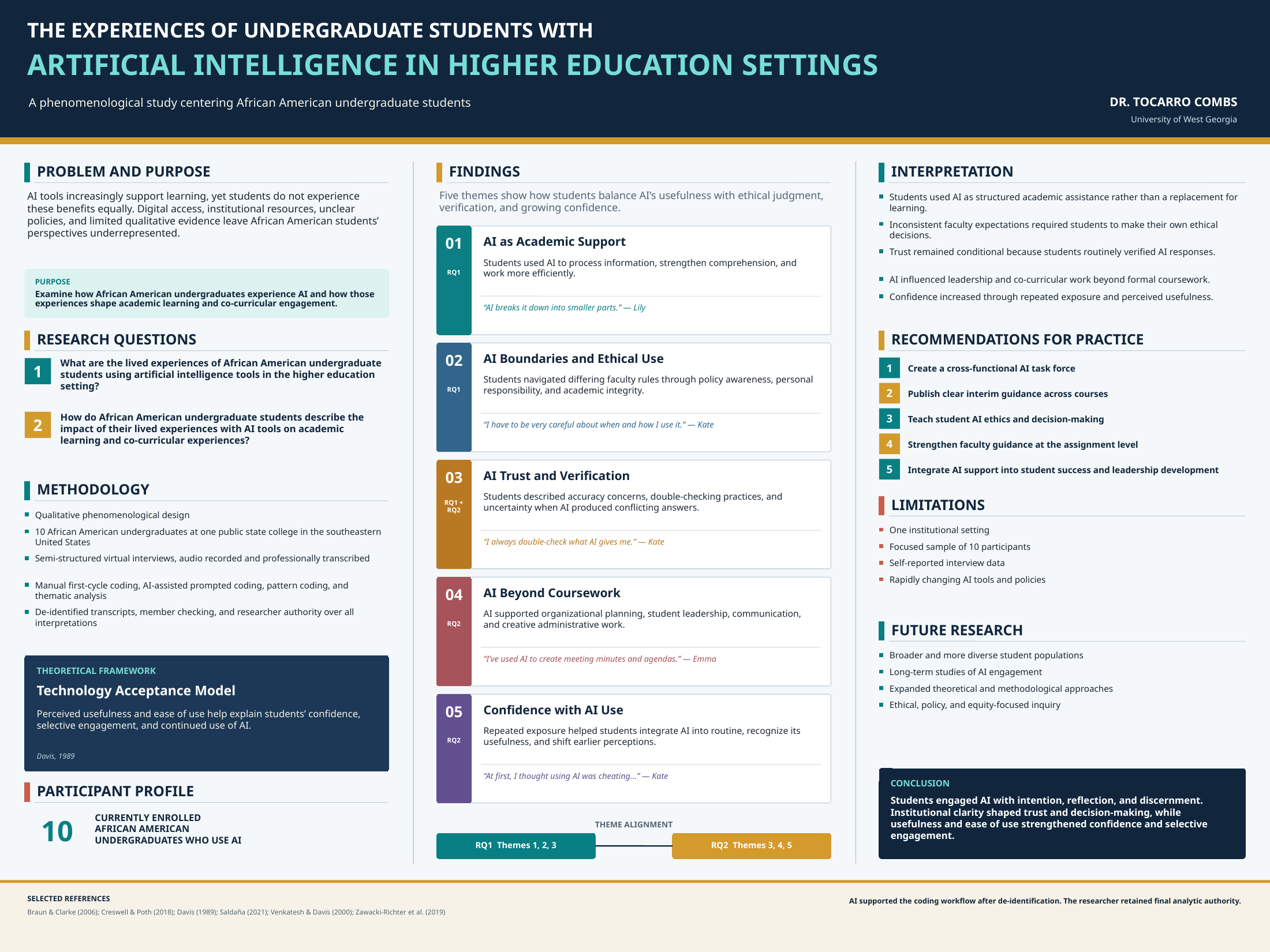
Dr. Combs’s qualitative study examined how ten African American undergraduates experienced AI in higher education, including academic learning and activities beyond coursework. These findings offer context for intentional use; the P.E.A.C.H. steps are a separate teaching framework.
Participants described help with processing information, comprehension, and efficiency.
Students navigated faculty expectations, personal responsibility, and academic integrity.
Participants raised accuracy concerns and described checking AI responses.
AI appeared in organizational planning, leadership, and creative or administrative work.
Repeated exposure shaped comfort and how students perceived AI’s usefulness.
Give students clear expectations for AI use, teach verification and ethical decisions, and make space for AI learning in student leadership as well as coursework.
Study context: ten participants at one public state college in the southeastern United States; semi-structured interviews and thematic analysis. The Technology Acceptance Model informed the study. Findings reflect these participants’ experiences and are not a measure of all students’ outcomes.

AI Strategist · Higher Education Leader
Dr. Tocarro Patrice Combs is a higher education leader, educator, and AI strategist with more than 15 years of experience across student engagement, leadership development, and student success. Her work focuses on the thoughtful use of AI in teaching and learning.
She earned her Ed.D. in Higher Education Administration from the University of West Georgia, where her research examined undergraduate students’ experiences with artificial intelligence. She was the first doctoral student at UWG to receive IRB approval to use AI for first-cycle coding in her thematic analysis.
Her passion for emerging AI technology, global education, and community leadership drives her to connect people, expand opportunity, and turn bold ideas into meaningful impact. She created the P.E.A.C.H. framework to help people use AI with purpose, clear boundaries, and human judgment.
LorRaine used Prompt Possibilities to create a prompt for her task. The result she shared: a functional budget calculator.
“Prompt Possibilities is phenomenal. I was able to create a functional budget calculator using my customized prompt.”— LorRaine
“This is awesome! Wow, my students could use this!”
“This was super cool & easy.”
Bryson created an interactive coloring sheet.
Add the P.E.A.C.H. web app to your Home Screen for quick access. Open this page on the phone you want to use, then follow its steps below.
The prompt builder and free workbook are available offline after the app loads once. Booking and checkout links require internet. This is a Home Screen web app, not an App Store download.
May we use optional analytics to see which guides and booking links people use? We do not send what you type into the prompt machine.